

The Cranberries
Berries. Berries. Berr-ies, -ies, -ies.

Possibly the most divisive Thanksgiving side dish is, in my completely unhumble opinion, an absolute essential. Cranberry sauce brings a tart bite that cuts through all of the heavy starches of the meal. Yet cranberries always take a backseat in diners’ hearts, never cracking the top 5 of favorite Thanksgiving sides in virtually any poll. For most people, either they’re an instant “ew,” or they don’t rise above comfort food standouts like sweet potato casserole, stuffing, mashed potatoes, green bean casserole, or mac n’ cheese (the traditional Top 5).
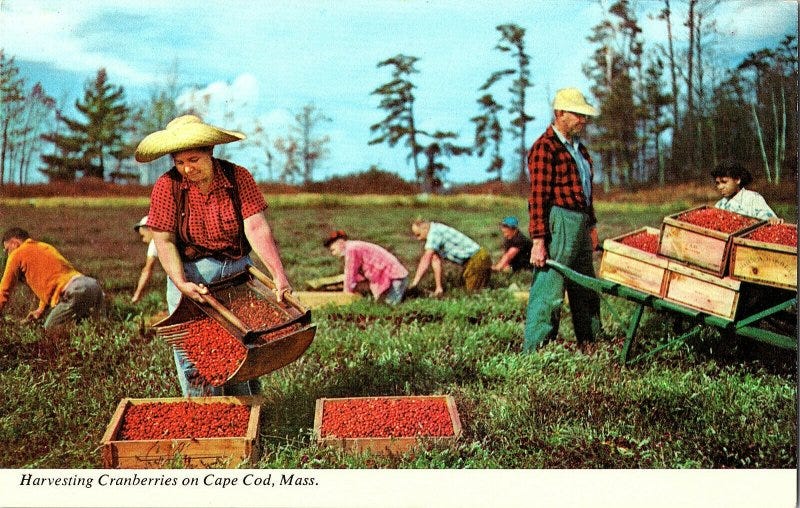
Cranberries are native to North America. Indigenous peoples used cranberries as food and dye long before white colonizers set foot on North American shores. Massachusetts colonists were likely introduced to the berry as a subsistence food by the Narragansett people. The cranberries folks enjoyed were foraged from the wild until 1816, when a Revolutionary War veteran began cultivating them as a crop in Cape Cod. They were first harvested by hand, utilizing a comb-like apparatus; today, about 10% of the US crop is still harvested this way and sold fresh.
For the rest, we get bogs, complete with spiders. Cranberry beds were first constructed in wetlands, utilizing natural water to float the berries to the surface for easier harvesting. Today, manmade dykes in upland areas with installed irrigation equipment house the berries. (Wolf spiders are introduced to the beds and used as a natural pesticide.) Cranberries are harvested when they turn red, generally after the first frost. Beds are flooded a few inches above the vines and berries are corralled with water reels. These berries are generally frozen or processed.
Fun fact: Ripe cranberries bounce! In the 1840s, a New Jersey grower named John “Peg Leg” Webb spilled a bushel of cranberries. They rolled down his cellar steps. He noticed that the cranberries that didn’t bounce their way to the bottom had gone bad. The Bounce Test is how cranberries are sorted to this day.
Being a seasonal New England fruit, it was natural that cranberries should become a part of Thanksgiving celebrations. Cranberries were often used as a tangy-sweet sauce for meats. Ulysses S. Grant ordered cranberry sauce to accompany Union soldiers’ 1864 Thanksgiving meal, helping popularize the dish among those outside of the Northeast.
Wet harvesting was invented in the early 1930s, making mass-scale production of cranberries commercially viable. Things really got bouncing for these little berries when a little growers’ co-op began manufacturing jellied canned cranberry sauce, selling it nationwide in 1941. Founded in 1930, Ocean Spray was established as a cooperative… making them immune to antitrust laws, allowing them to set better prices for their members without any pesky monopoly accusations. Being canned, the sauce was available to areas of the country where fresh cranberries might be in short supply, and offered more cheaply. The jellied “log” of cranberry sauce was considered quite festive on its own, though many preferred to slice and arrange it in a pleasing fashion.
Wait… why is it jellied? Cranberries love to gel! They contain a lot of pectin compared to other fruits, which is the soluble fiber that helps the jelly set. All that pectin helps them stay firm and bouncy while the berry is whole. When cooked, that pectin seeps out, trapping dissolved sugar to thicken the liquid. However, most “loose” sauces stop short of creating a true gel. You can get canned cranberry sauce that’s not completely jellied. However, most consumers just prefer the texture of the smooth, jellied sauce.
Today, people still prefer the tradition of the jelly log. According to Ocean Spray, they sell 70 million cans of cranberry sauce each year (with 80% of that around Thanksgiving and Christmas) and just 20 million bags of fresh cranberries. As for me and my table, it’s fresh, homemade cranberry sauce or cranberry relish. But if you crack out the stuff in a can, you can still count on me to be the guy who finishes it.
Wait… how do I get it out of the can? If you look closely at a can of Ocean Spray jellied cranberry sauce, you’ll notice it looks a little… odd. The can is actually intentionally packaged upside down! This creates an air bubble at the top of the can, making it easier for the sauce to come loose. Open the can, gently run a knife around the sides of the sauce, and invert it onto a plate. The log should come out with that signature slurp! If your can isn’t upside down, just jiggle it to move some air behind the sauce.